
What Is a Modern PR Agency?
The PRSA defines public relations as "a strategic communication process that builds mutually...

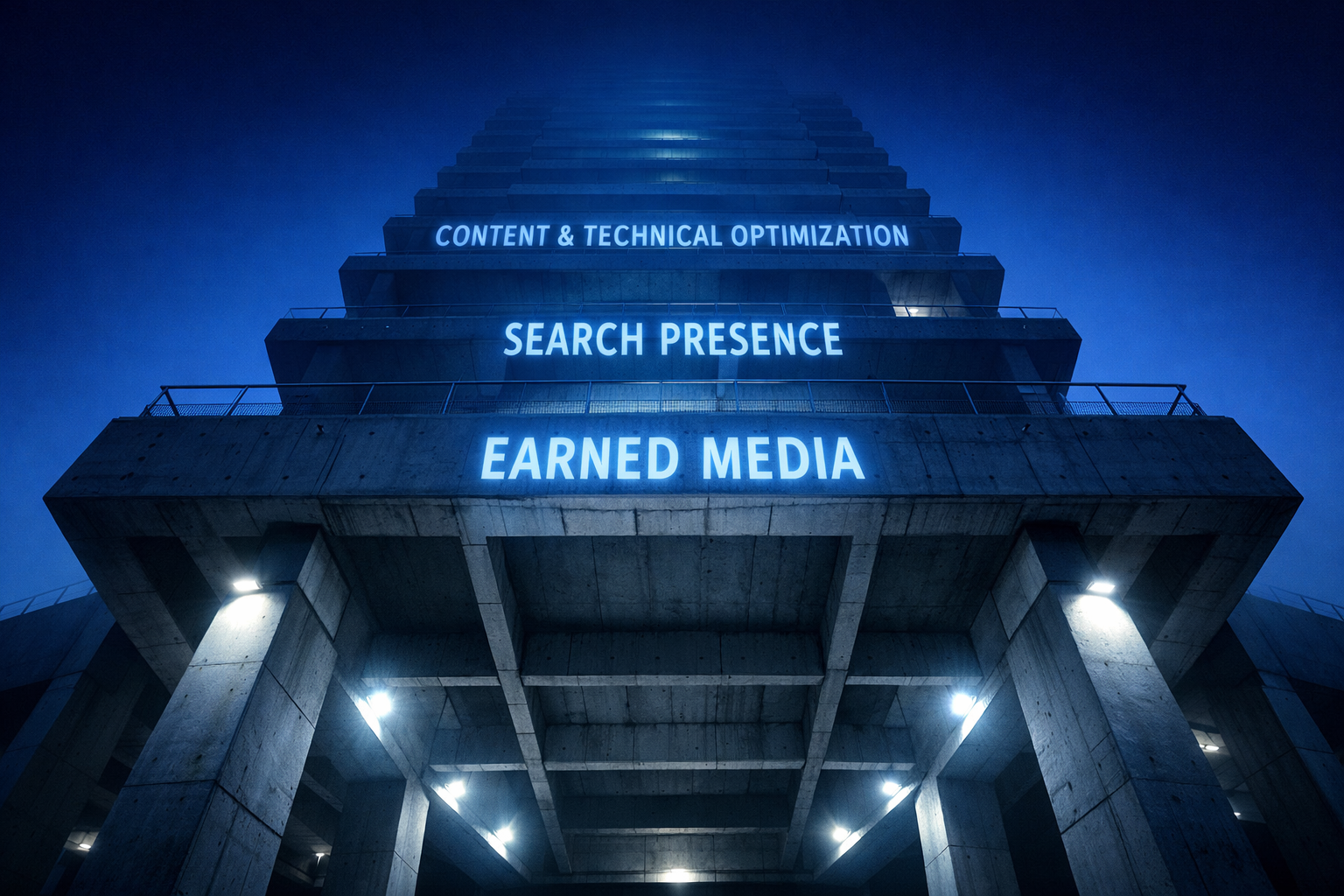
The short answer: Generative Engine Optimization (GEO) agencies optimize content and technical structure to improve AI citation rates. What they cannot do is build the earned media authority that research consistently identifies as the highest-weight input to AI recommendations. That requires a PR program — and most GEO agencies have never run one.
If you are a B2B marketing leader in 2026, you have almost certainly been pitched on GEO. Generative Engine Optimization has become one of the fastest-growing service categories in digital marketing, with dozens of agencies now offering to improve your brand’s visibility in ChatGPT, Perplexity, Google AI Overviews, and Gemini.
The pitch usually goes something like this: AI systems are the new search engines. We know how to optimize for them. Give us your content and we’ll make sure AI recommends you.
It’s a compelling pitch. It’s also missing the most important part of the problem.
GEO, or Generative Engine Optimization, is the practice of structuring and formatting content so that AI systems are more likely to pull from it when generating answers. The term was formalized in a 2024 academic paper from researchers at Princeton, IIT Delhi, Georgia Tech, and the Allen Institute for AI (Aggarwal et al., arXiv:2311.09735, ACM KDD 2024). Their research tested which content modifications most reliably improved a page’s appearance in AI-generated responses.
The most effective techniques they identified were adding specific statistics with named source attribution, including authoritative quotes, and structuring content to provide direct, quotable answers to specific questions. These techniques improved AI citation rates by measurable margins — the “Statistics Addition” method improved citation visibility scores by 32.8 percent; “Quotation Addition” led all methods at 42.6 percent.
GEO agencies have built service lines around these findings. They audit your content for AI-readiness, optimize page structure for answer engine pickup, implement schema markup and structured data, manage your brand’s entity presence across Wikipedia and Wikidata, and track your citation rates across AI platforms.
These are real and useful services. But they are the optimization layer — not the foundation.
Here is the question GEO agencies rarely answer directly: why would an AI system recommend your brand in the first place?
AI systems don’t recommend brands because those brands have well-structured content. They recommend brands because the accumulated record of what the web says about those brands — the editorial coverage in authoritative publications, the peer reviews on respected platforms, the cited research, the consistent authoritative mentions over time — gives the AI reason to consider them credible and worth recommending.
This is not a hypothesis. It is the most consistent finding in AI visibility research to date.
Ahrefs analyzed 75,000 brands and found that branded web mentions in authoritative publications correlate with AI Overview visibility at a Spearman coefficient of 0.664 — the strongest correlation of any signal measured in the study, stronger than backlink count (0.218), domain rating, or any content or technical factor. Muck Rack’s analysis of more than 25 million links found that earned media accounts for approximately 82 to 84 percent of all AI citations, with 94 percent of citations coming from non-paid sources. Stacker’s 2026 research across 87 earned media stories and 2,600 AI prompts found a 239 percent median lift in AI citations from distributed earned media versus owned content alone.
The signal that most reliably predicts whether AI recommends your brand is not your schema markup. It is not your content structure. It is whether credible, independent, editorial sources have written about you — and whether they keep writing about you.
That is an earned media problem. And earned media is a PR discipline.
The stakes of getting this right have risen sharply. G2’s “The Answer Economy” report, published in April 2026 based on a survey of 1,076 B2B software buyers, found that 51 percent of B2B software buyers now begin vendor research in an AI chatbot rather than Google — up from 29 percent eleven months earlier. Seventy-one percent rely on AI chatbots for software research overall. Sixty-nine percent chose a different vendor than they initially planned based on AI guidance.
Idea Grove’s own 2026 consumer research, conducted via Pollfish with 1,000 U.S. adults, found that 69 percent of buyers are more likely to choose a brand that has press coverage over one that does not. Only 2 percent of consumers buy from an AI-recommended brand without verifying it first — meaning AI visibility and brand credibility work together, not in isolation.
The brands that are not showing up in AI-generated answers are not suffering from a technical deficiency. They are suffering from a trust deficit. Their earned media footprint is too thin for AI systems to draw on when forming recommendations. No amount of content optimization closes that gap.
The Trust Signals® Framework, developed at Idea Grove and introduced in Scott Baradell’s 2022 book Trust Signals: Brand Building in a Post-Truth World, organizes AI visibility into five categories of brand authority. Understanding which categories GEO agencies address — and which they don’t — clarifies exactly where the gap lies.
The highest-weight category. Earned media coverage in authoritative publications, editorial mentions, industry awards, and any credible independent endorsement of your brand. The Ahrefs 0.664 Spearman correlation sits here. GEO agencies do not build this. It requires a PR program with real editorial relationships and a track record of placing clients in publications AI systems draw on as authoritative sources.
Customer reviews on the platforms AI systems cite for product recommendations — G2, Capterra, Gartner Peer Insights, TrustRadius, Glassdoor. SE Ranking’s November 2025 analysis of 129,000 domains found that brands with profiles on major review platforms have approximately three times higher ChatGPT citation rates than brands without them. GEO agencies can audit your review presence. They typically do not run the client programs that generate it.
Website quality, content depth, Core Web Vitals performance, and the technical infrastructure — including schema markup and structured data — that makes your brand’s authority legible to AI systems. This is the layer GEO agencies know best. It matters, and it is worth investing in. But it works only when built on top of genuine earned authority.
Organic search authority, branded search volume, and traditional SEO signals. Ninety-seven percent of Google AI Overviews cite at least one source from the top 20 organic results — meaning search authority and AI visibility are, for most brands, the same investment. The more durable path to search presence runs through earned media that generates authoritative backlinks and branded search volume.
Original content, research, and expert positioning that other credible sources cite. A well-executed original research study that earns coverage in authoritative publications creates more AI citation value than months of content optimization on owned channels — because AI systems weight cited content from authoritative sources far more heavily than self-published content, regardless of how well that content is structured.
A PR agency with an AI visibility practice approaches the problem from the foundation up, not the optimization layer down.
The starting point is an honest assessment of where your earned authority stands today. What does your media coverage look like in the publications that matter in your category? What is your review presence on the platforms your buyers consult? What original research or thought leadership has your organization produced that other credible sources have cited? What does AI actually say about your brand when buyers ask about your category — and how does that compare to what it says about your strongest competitors?
From that audit, the work becomes clear. For most B2B brands — especially those in enterprise technology, manufacturing software, supply chain solutions, and similar complex categories — the gap is almost always in earned media volume and review platform presence. These brands have press releases and trade show mentions, but not the sustained editorial relationships and consistent coverage in authoritative publications that AI systems use as primary evidence of credibility.
Closing that gap requires a genuine PR program with real journalist relationships, consistent and newsworthy client stories, original research that earns coverage, and the sustained investment over time that compounds into a durable authority footprint.
Once that foundation is in place, content optimization and technical infrastructure — the GEO layer — amplifies what already exists. Schema markup makes earned authority legible to machines. Well-structured content gives AI systems quotable material to pull from. These investments matter. They just don’t come first.
When evaluating AI visibility services, there is one question that cuts through the complexity: what is your plan for building my earned media authority?
If the answer is primarily about content creation, technical optimization, and schema implementation — with earned media as a footnote or a “nice to have” — you are looking at an optimization-layer solution for a foundation-layer problem.
The brands that will own their categories in AI-mediated search five years from now are not the ones that had the best schema in 2026. They are the ones that spent the past several years building the kind of brand that the web, independently and cumulatively, decided was worth citing. They have the media coverage, the peer reviews, the industry recognition, and the cited research that reflect sustained investment in genuine credibility.
That is what AI trust signals are. That is what the Trust Signals® Framework is designed to build. And that is the work — the PR-first, earned-authority-first work — that Idea Grove has been doing for B2B brands for twenty years.
GEO (Generative Engine Optimization) optimizes content structure and technical infrastructure to improve how AI systems read and cite your pages. PR builds the earned media authority — coverage in credible publications, cited research, editorial mentions — that AI systems use as the primary basis for brand recommendations. GEO amplifies existing authority. PR builds it.
Branded web mentions in authoritative publications. Ahrefs’ analysis of 75,000 brands found this to be the single strongest predictor of AI Overview visibility, with a Spearman correlation of 0.664 — stronger than backlinks, domain rating, or any technical signal.
Technical and content improvements can make marginal differences, particularly for brands that already have some earned authority. But for brands with thin media footprints, GEO and AEO alone will not produce meaningful AI visibility. The foundation has to be built first.
The Trust Signals® Framework is a registered methodology developed by Scott Baradell at Idea Grove that organizes brand authority into five categories — Third-Party Validation, Reputation Management, User Experience, Search Presence, and Thought Leadership — each of which functions as an AI trust signal. The framework was introduced in Baradell’s 2022 book Trust Signals: Brand Building in a Post-Truth World and has been updated to reflect the AI visibility research published since.

The PRSA defines public relations as "a strategic communication process that builds mutually...
The growing recognition that AI has made generic content less valuable has produced a predictable...